You know the feeling: Halloween decorations are barely down, and suddenly every competitor is blasting Black Friday deals. The inbox clutter is real, customers are choosy, and your budget is tighter than ever. So, how do you cut through the noise and turn Black Friday into a win for your small brand? In this guide, you’ll get a practical, week-by-week black friday marketing strategy for 2026, packed with ideas, campaign examples, and proven email tactics to help you stand out, even on a limited budget.
Key takeaways
- Start your Black Friday marketing strategy early, October is not too soon.
- Focus on building your list, warming up your audience, and segmenting offers.
- Multi-channel campaigns, email, SMS, and retargeting, drive higher conversions.
- Scarcity and early access strategies boost urgency and sales during the holiday rush.
What makes a strong Black Friday marketing strategy in 2026?
A strong Black Friday marketing strategy for 2026 starts early, uses multiple channels, and focuses on personalization and urgency to reach budget-conscious shoppers and maximize sales.
“Black Friday marketing strategy” means a coordinated set of actions, planning, messaging, and campaigns, designed to attract, engage, and convert customers during the Black Friday and Cyber Monday shopping period. In 2026, US holiday retail sales are forecast to grow, with cost-conscious buyers seeking value and early deals (source). This means your strategy must be sharp, efficient, and customer-focused from the start.
How early should you start planning your Black Friday marketing?
Begin planning your Black Friday marketing at least eight weeks ahead, by early October, to give yourself time to build lists, test messaging, and schedule campaigns.
Shoppers are starting earlier each year, hunting for deals before November even begins (source). Early planning means you can:
- Grow and segment your email and SMS lists
- Warm up your audience with content and sneak peeks
- Stress-test your website and checkout for high traffic
- Prepare inventory and fulfillment plans
| Timeline | Key Actions |
|---|---|
| 8 weeks out (early Oct) | Plan offers, build lists, review site readiness |
| 6 weeks out | Announce early access, launch lead magnets |
| 4 weeks out | Segment audiences, test campaigns, set up retargeting |
| 2 weeks out | Preview deals, send warming emails/SMS, check inventory |
| Black Friday week | Launch main campaigns, monitor and optimize |
What are the best Black Friday marketing ideas for small brands?
The best Black Friday marketing ideas for small brands focus on early access, scarcity, and multi-channel engagement to create excitement and drive conversions.
Here are tested ideas that work for smaller budgets:
- Early access offers: Give your email or SMS subscribers first dibs on deals.
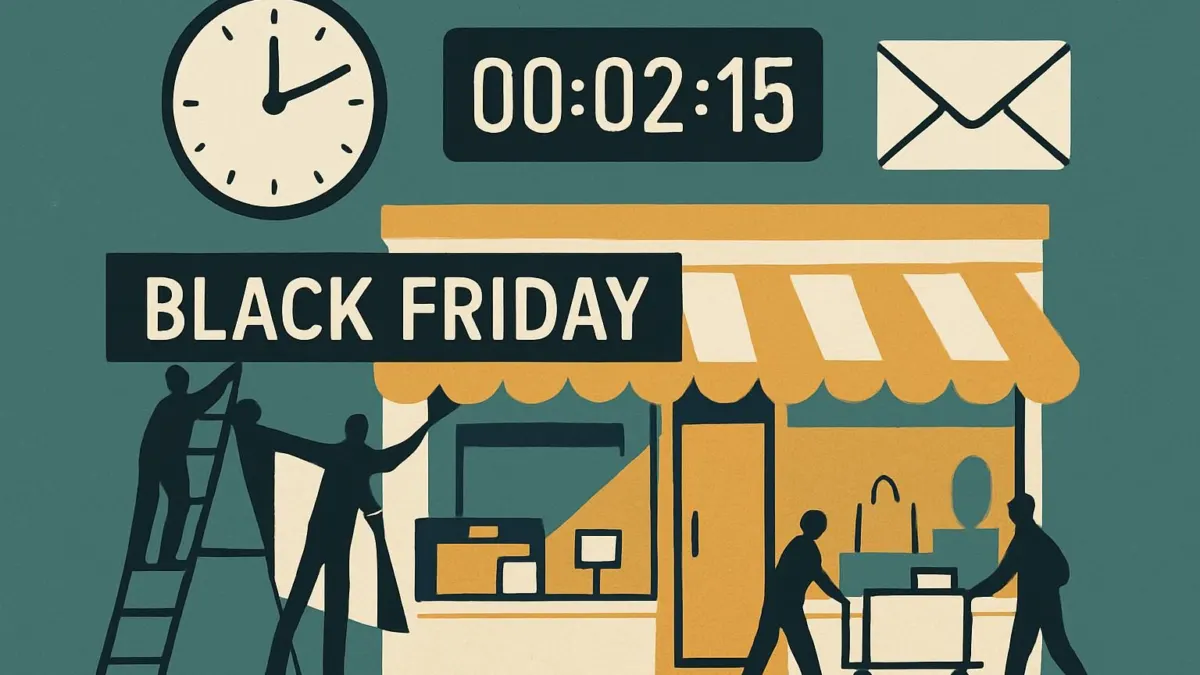
- Scarcity tactics: Use limited stock, countdown timers, or expiring bonuses to drive urgency.
- Bundled deals: Pair popular products with bestsellers for a higher average order value.
- Personalized recommendations: Send tailored offers based on past purchases.
- Gift card bonuses: Offer bonus credit on gift card purchases (for example, $100 for $85).
- Shoppable content: Use short product demo videos or tutorials on social and email.
How do you structure Black Friday marketing campaigns for maximum impact?
Structure your Black Friday marketing campaigns with a phased approach: tease, launch, peak, and last chance, coordinated across email, SMS, and retargeting ads.
A typical campaign sequence might look like this:
- Teaser & list building (3-4 weeks out): Tease upcoming deals, run “early access” sign-ups, set up popups.
- Early access (1 week out): Send exclusive deals to subscribers and SMS list.
- Main event (Black Friday-Cyber Monday): Launch broad campaigns, rotate deals, and use urgency messaging.
- Last chance (Cyber Monday PM): Remind customers of expiring offers and limited stock.
| Phase | Channel | Message Example |
|---|---|---|
| Teaser | Email/Popup | “Something big is coming, get early access!” |
| Early Access | SMS/Email | “Your exclusive Black Friday deal starts now!” |
| Main Event | Email/Social/Ads | “Black Friday is here: Shop our best offers” |
| Last Chance | Email/SMS | “Only hours left, shop before deals end!” |
This phased approach keeps your brand top-of-mind and encourages repeat visits throughout the sale window.
What should your Black Friday marketing emails include?
Effective Black Friday marketing emails should include a clear offer, urgency cues, simple design, and one call-to-action, sent as part of a sequence, not just a one-off blast.
Here’s what to include:
- Subject lines: Direct, urgent, and benefit-led (for example, “Black Friday Early Access: 30% Off Ends Tonight”).
- Personalization: Use the customer’s name and recommended products.
- Scarcity: Mention limited quantities or time left.
- Visuals: Simple, mobile-friendly design with clear product images.
- Call-to-action: One primary button (for example, “Shop Now”).
- Teaser (announce what’s coming)
- Early access (exclusive to subscribers)
- Main launch (all customers)
- Reminder (24 hours left)
- Last chance (final hours)
How do you use SMS marketing and retargeting for Black Friday?
SMS marketing and retargeting are powerful for Black Friday because they reach shoppers instantly and bring back those who almost purchased.
SMS marketing means sending short, time-sensitive messages to your list’s phones. Send:
- Early access codes
- Deal reminders
- Low-stock alerts
- Last-chance offers
SMS open rates are often very high during Black Friday, making it one of the most effective channels for urgent promotions (source).
Just remember: always get consent for SMS and keep messages short and relevant.
How do you create urgency and scarcity without discounting too much?
You can create urgency and scarcity by limiting quantities, offering time-bound bonuses, or giving early access, without slashing prices across the board.
Try these tactics:
- Set aside a set number of discounted bundles or exclusive products for your “VIP” list
- Offer free shipping or a gift for the first 100 orders
- Use countdown timers in emails and on your site
- Publicize low stock numbers or “sold out” items
What does a week-by-week Black Friday marketing plan look like?
A week-by-week Black Friday marketing plan breaks down actions, email sequences, and campaign launches for maximum readiness and impact.
Here’s a sample calendar for 2026:
| Week | Focus | Actions |
|---|---|---|
| Early Oct (7-8 weeks out) | Prep & List Building | Segment audience, optimize website, launch early access signup |
| Mid Oct (5-6 weeks out) | Warm Up | Send teaser emails, share social sneak peeks, run lead ads |
| Late Oct (3-4 weeks out) | Early Access | Send early access codes to email/SMS, test site checkout |
| Early Nov (2 weeks out) | Preview Deals | Email/SMS: deal previews, retarget site visitors, check inventory |
| Black Friday Week | Main Event | Launch campaigns, monitor performance, send reminders |
| Cyber Monday | Last Chance | Send final reminders, promote urgency, thank customers |
Each stage builds momentum, keeps your list engaged, and maximizes your reach when it counts. For more tactical content, explore the Marketing category on Topicspedia.
How do you measure Black Friday campaign success?
Measure your Black Friday campaigns by tracking sales, conversion rates, new customers, and engagement across email, SMS, and ads.
Key metrics to monitor:
- Total sales and average order value
- Email and SMS open and click rates
- Cart abandonment and recovery rates
- New vs. returning customer ratio
- Ad spend and return on ad spend (ROAS)
Taking your Black Friday marketing strategy further
Building a black friday marketing strategy that works in 2026 means starting early, engaging your audience across channels, and focusing on value, not just discounts. As you plan your campaigns, keep iterating on what gets results, test email subject lines, segment your offers, and review your data after the sale. For more guidance on seasonal promotions and digital tactics, check out Topics A to Z and the latest advice in our Marketing resources.
Frequently asked questions
What are some effective marketing strategies for Black Friday?
Effective Black Friday marketing strategies include building early access lists, using scarcity tactics like limited-time offers, personalizing campaigns with customer data, and coordinating multi-channel outreach through email, SMS, and retargeting ads. These approaches help small brands compete by emphasizing urgency and value, rather than relying solely on deep discounts.
What is the 3-3-3 rule for marketing?
The 3-3-3 rule is a messaging framework where you have 3 seconds to catch attention, 3 minutes to engage the audience, and 3 hours to spark action. For Black Friday, this means your messaging and offers must be clear, immediate, and compelling, especially in crowded inboxes and social feeds.
What are some creative Black Friday marketing ideas?
Creative Black Friday marketing ideas include offering early access to VIPs, bundling products for exclusive deals, using shoppable videos or influencer partnerships, and providing limited-edition items. These ideas stand out by adding value and excitement, not just lowering prices, and can be adapted for brands with smaller marketing budgets.
What are some effective Black Friday marketing campaigns?
Effective Black Friday marketing campaigns use a phased sequence, teasers, early access, main event, and last chance, across email, SMS, and retargeting. Successful campaigns focus on urgency, exclusivity, and simplicity, driving shoppers to take action while reinforcing the brand’s value and credibility.
How can small brands compete with big retailers on Black Friday?
Small brands can compete by focusing on personalized offers, community engagement, and early access for loyal customers. By using targeted email and SMS campaigns, emphasizing unique value, and creating a memorable customer experience, small brands can stand out and drive sales, even in a crowded market.